Ecstasy/MDMA
Description
MDMA, sometimes called ecstasy in the pill form, is an ‘entactogen’/‘empathogen’ drug; a drug which produces marked feelings of empathy or emotional understanding in and between individuals. The two names refer to the same drug but historically “MDMA” was associated with the powder/crystal form of the substance. Today the names could be considered interchangeable, as MDMA pills are also widely found on drug menus.
After limited use in psychotherapy prior to its ban in the mid-1980s, MDMA has re-emerging as a treatment (MDMA-assisted psychotherapy) for post-traumatic stress disorder (PTSD) in certain countries.
Desirable Effects
- Sense of euphoria
- Feelings of empathy or emotional understanding in and between individuals
- Increased energy
- Increased sociability
Undesirable Effects
- Bruxism/’gurning’
- Raised blood pressure and heart rate
- Raised body temperature
- ‘Comedown’ (usually depressed and tired feeling) as effects wear off
- Dehydration
What does it look like?
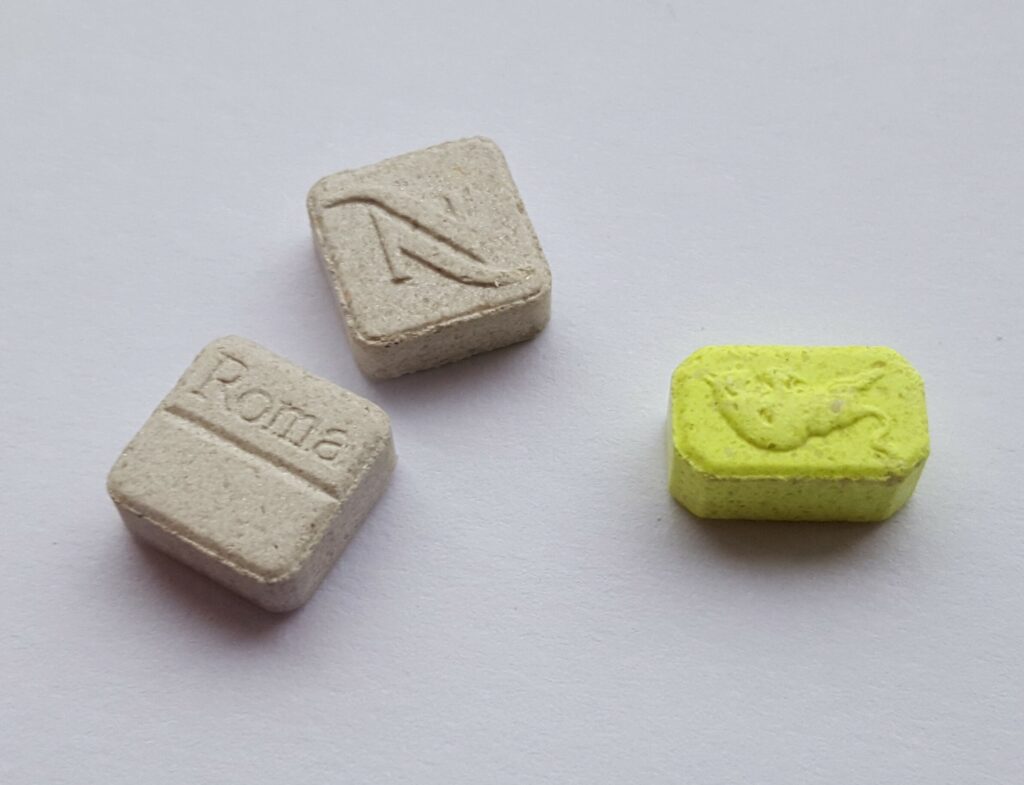
Pills are found in varying colours and designs. Crystal is usually sold as brown or off-white small shards in bags of 1 or more grams. Powder form is similar to crystal, but is just the crystals in a crushed form. The colour of MDMA crystal or powder can vary and should not be taken as any form of indication of substance purity or potency.
Method of Use
Swallowed: Pills are typically swallowed. Powder/crystal can also be swallowed by dissolving in a beverage, or taken as a ‘bomb.’ A ‘bomb’ is prepared by wrapping individual doses in thin paper such as cigarette or tissue paper, which is then swallowed. Empty gel capsules are also sometimes purchased for this. The capsules are sometimes used such that the user can prepare ahead of time for using. In this case, they weigh their dose out, fill their capsule accordingly, and then later take the capsule when ready. The same is true of bombs, although the more fragile nature of the wrapping can mean that they are less ideal for transport and later consumption.
Snorted: usually divided into lines and snorted (insufflated) via rolled up paper or plastic straws, or ‘bumped’/’keyed’ i.e. small amount sniffed
Pharmacology
MDMA acts on a range of neurotransmitter systems in the brain; increasing serotonin, noradrenaline and dopamine levels to induce entactogenic and stimulant effects. It primarily acts as a monoamine releasing agent with a slight preference for serotonin over noradrenaline and dopamine. MDMA enters nerve cells through the monoamine transporters (SERT > NET, DAT) and reverses their direction. This causes serotonin, dopamine and noradrenaline to pour out of the neuron into the synapse, where they activate their respective receptors. To a lesser extent, a serotonin-noradrenaline-dopamine reuptake inhibitor (SNDRI). MDMA also acts on VMAT2 in a similar way to amphetamine, contributing to its ability to induce the release of monoaminergic neurotransmitters (for more information, see Amphetamines). Serotonin levels in the brain are thought to be depleted after MDMA use leading to the ‘comedown’, but typically return to normal within a couple of days.
It’s suggested that the oxytocin signalling system is involved in MDMA’s pro-social effects. In a Swiss study by Atila and colleagues, MDMA elevated oxytocin levels and produced its strong entactogenic effects in healthy patients, but failed to do the same in people with a genetic oxytocin deficiency.
MDMA’s weak psychedelic effects, though milder than the related drug MDA, are mediated by the serotonin 5-HT2A receptor. Meanwhile, MDMA’s activation of the 5-HT2B receptor, if repeated over the long term, is thought to be responsible for an increased risk of organ complications (e.g. valvular heart disease).
The duration of effects of MDMA is between 3–6 hours, with effects starting between 20 min and 1.5 hours after oral consumption. It’s thought that the short duration (compared to its elimination half life between 8–9 hours) is due to the brain rapidly developing a temporary tolerance to the drug’s effects. MDMA is broken down into several active metabolites including MDA primarily in the liver by a range of enzymes including COMT and CYP2D6.
MDMA interacts with a number of different drugs. There have been several deaths from people taking MDMA while on ritonavir, a CYP2D6 inhibitor. As a serotonergic drug, taking MDMA with MAOIs can lead to a life-threatening condition called serotonin syndrome. SSRIs and SNRIs have been known to block most of the subjective effects of MDMA.
Harm Reduction
- Weigh your shit
- Note about dissolving / issue of overdosing if MDMA settles in the bottom
- Start low, go slow: Take a small amount and wait until you can feel the effects before taking more/anything else
- Try not to use alone: If something goes wrong, someone is there to get help
- Be careful mixing: Mixing MDMA with other drugs can increase health risks and lead to overdose – avoid if you can, otherwise take less of each, as they can increase the effects and risks
- Carry naloxone: Some counterfeit drugs in the UK have been found to contain strong opioids
- Test your stuff: Some ecstacy/MDMA pills in the UK have been found to contain cathinones or amphetamines, and you can’t see this by eye. Find out how to send a sample to WEDINOS for testing here: https://www.wedinos.wales or pick up some test strips at our Harm Reduction Hub
- Stay hydrated: it’s recommended to sip one pint of non-alcoholic liquid (not more) per hour.
- Stay cool: Dancing can make you forget how hot and sweaty you are. Set a timer to take a break every hour and get some fresh air: this is important to reduce the risks of dehydration and overheating.
- Landing safely: Stay hydrated and fed, and take it easy for the next few days – remember that it will pass. Taking drugs like benzodiazepines as come-down aids may have some benefits, but can lead to dependence and legal issues.
- It’s possible to become psychologically dependent on the drug (feeling like you need it all the time). If you think this is happening, see your doctor as soon as possible, but don’t suddenly stop taking it.
- You should avoid taking ecstasy/MDMA if you have:
- high blood pressure,
- heart disease,
- epilepsy (or family history of epilepsy),
- diabetes or liver problems.
- You should also avoid using it if you have had psychiatric problems like depression or anxiety. The combination of MDMA and flashing lights in clubs can make some people more susceptible to seizures. Take advice if you are unsure.
History
MDMA was ‘rediscovered’ by Dr Alexander Shulgin who, although in official retirement, was the sole holder of the licence given by the Government of the United States to develop compounds that may have health and commercial benefits. Shulgin spent a lot of time working on the phenethylamine group of drugs of which MDMA (first synthesised by Merck just before the First World War) belongs to. It was used as a tool in psychotherapy, and its rediscovery pushed it back into that field again. It was found that the drug had disinhibiting qualities that promoted feelings of ‘empathy’ and ‘openness’ which helped couples with relationship challenges. As it gained popularity amongst students as a ‘party’ drug in the US, the name ‘E’ (short for ‘ecstasy’, although it may originally have been intended to stand for ‘empathy’, which could be considered more logical) became associated with it.
Ecstasy’s use and popularity magnified with the dance rave culture in the late 1980s. This continued for around a decade, after which a great decrease in purity was seen along with a move away from the dance scene and perhaps associated with the ageing 80s ‘clubber’ generation. However, the turn of the 21st century saw another big explosion of Ecstasy use. This time round, MDMA powder became more popular as a purer form, probably due to the very low quality of pills found at the time.
The COVID-19 pandemic saw a decline in non-prescribed ecstasy consumption, as clubs shut their doors. However, this dip in popularity quickly bounced back as social distancing rules were relaxed. The early 2020s saw a rise in strength of MDMA pills, from an average of 162 mg in 2022 to 192 mg in 2025. Meanwhile, the resurgence of mephedrone and other cathinones has filtered into a portion of missold MDMA pills on the unregulated market.
MDMA-assisted psychotherapy in the 21st century
In 2017, the US FDA granted breakthrough therapy designation for MDMA-assisted therapy for PTSD. The early 2020s saw increased, but still limited, medical access to MDMA in certain countries, though it remains illegal in most places. In 2022, the Canadian government began issuing special access programme authorisations to practitioners conducting activities with psilocybin and MDMA. In 2023, the Australian government reclassified MDMA and psilocybin to enable access for use in psychotherapy for specific treatment-resistant mental health conditions. Companies such as Resilient Pharmaceuticals (formerly Lykos Therapeutics, MAPS PBC) continue to study MDMA-assisted therapy as a treatment for PTSD alongside other conditions like depression and social anxiety disorder.
Law
- Class A
- Schedule 1
Possible offences
- Possession
- Maximum sentence – 7 years/fine/both
- Possession With Intent To Supply
- Maximum sentence – life imprisonment/fine/both
- Supply (including being concerned in supply, conspiracy to supply, aggravated supply and offer to supply)
- Maximum sentence – life imprisonment/fine/both
- Production
- Maximum sentence – life imprisonment/fine/both
In practice maximum sentences are rarely used, for more detailed and accurate information go to our sentencing page.