Description
Alkyl nitrites or ‘poppers’ are a group of liquid chemicals that act by allowing more blood into the heart and creating the feeling of a ‘rush’. The most common medical nitrite is amyl nitrite, but most poppers bought for recreational use in the UK are usually the less potent butyl nitrite.
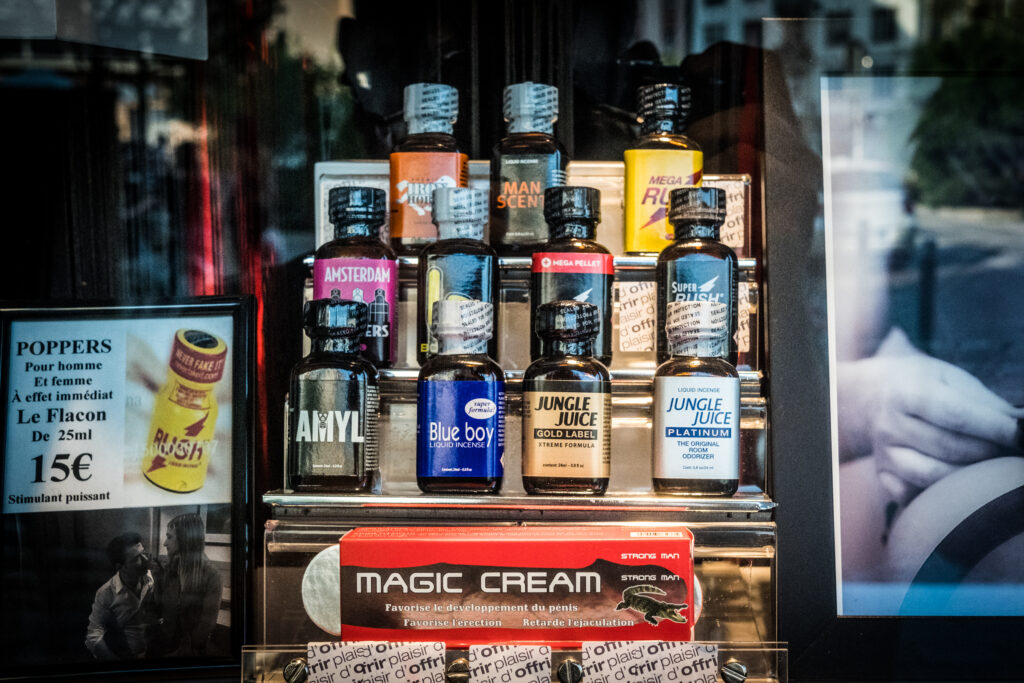
Alkyl nitrites come in little bottles with screw or plug tops, under various trade names such as TNT, Rush, Raw and Liquid Gold. They are generally inhaled, after which the effects of the drug start after about 15 seconds and last for up to 3 minutes.
Desirable Effects
- Short high/rush
- Enhanced sexual experience
- Muscle relaxation
Undesirable Effects
- Headache
- If poppers are stale, can make you feel sick/faint
- Can negatively affect people with heart problems
- In rare cases, vision problems at high, frequent doses
What does it look like?
Poppers come in small bottles with screw or plug tops. The liquid is a yellow colour and they smell sickly sweet.
Method of Use
Sniffed: Poppers are sniffed (inhaled) from the bottle. Sometimes, individuals soak fabric or cotton wool in poppers before inhaling to avoid spillages.
Swallowing poppers can be fatal and should receive immediate medical attention.
Pharmacology
Amyl nitrite is an antihypertensive (reduces blood pressure) medicine, through its vasodilatory (expanding blood vessels) action, which allows more blood to be delivered to the heart. Alkyl nitrites act as a source of nitric oxide (NO), a signalling molecule produced naturally in the body to relax smooth (involuntary) muscles and widen blood vessels. This is thought to be the main reason why it produces a euphoric effect and can facilitate easier penetration during sexual activity for some. It is also used to treat heart diseases such as angina and has been used to treat cyanide poisoning in the past (although they have been discontinued from most cyanide kits), due to its ability to increase levels of methemoglobin (a type of haemoglobin) in the blood.
Alkyl nitrites include:
- Amyl (isoamyl/isopentyl)
- Pentyl (n-pentyl)
- Butyl (n-butyl)
- Isobutyl (2-methylpropyl)
- Isopropyl (2-propyl)
- Hexyl nitrite
Different types of alkyl nitrites can carry different risks. Isopropyl nitrite is associated with eye damage (maculopathy and foveal damage). Isobutyl nitrite is suggested to be possibly carcinogenic to humans, and has been banned from sale as poppers in the EU and US.
Interactions
Taking alkyl nitrites alongside other vasodilators such as sildenafil (Viagra), tadalafil (Cialis) and nitroglycerin can increase the risk of strokes and fainting due to dangerously low blood pressure.
History
Amyl nitrite was first introduced in the 19th Century as a treatment for angina. Poppers became part of the club culture scene in the 70s to the 80s and again popularised in the 90s in the rave scene. In the following decade, its use dropped again, but it seems to have picked up in the 2010–20s.
Since their popularisation as a recreational drug, poppers have been associated with the gay community. A survey in the mid-to-late 2010s found that more than a third of US gay men had taken poppers at least once. Australian singer Troye Sivan’s 2023 song ‘Rush’ was partially inspired by the poppers brand.