
← Back to Drugs A–Z
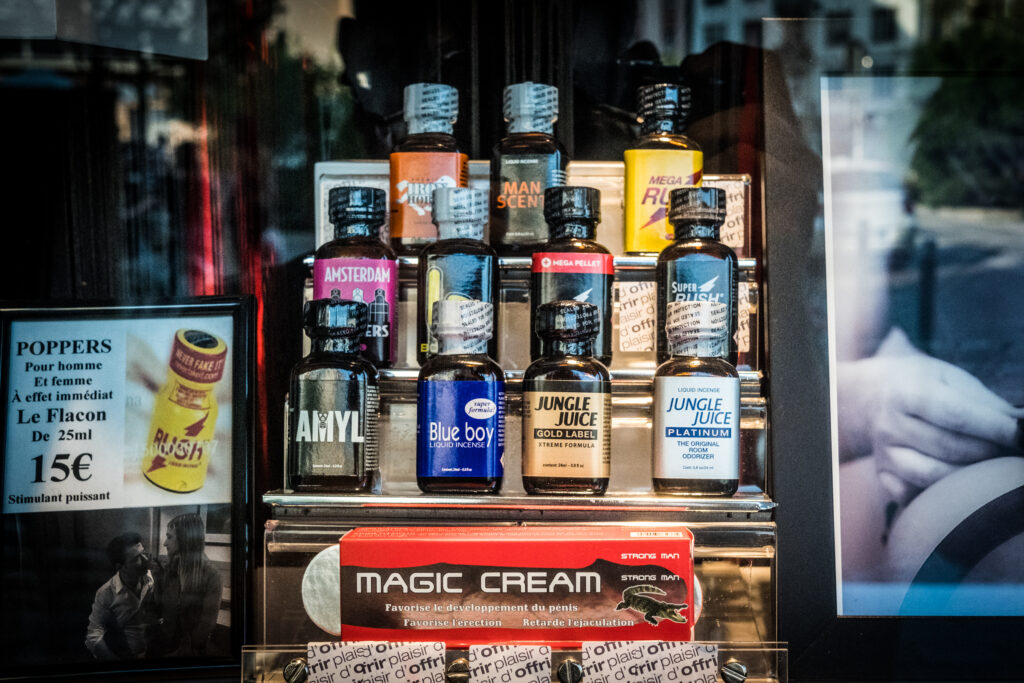
Alkyl nitrites (‘poppers’)
Group:
Depressants
Tags:
Vasodilators
Nicknames:
poppers, amyl, liquid gold, TNT, Rush, Raw, jungle juice
Last reviewed: October 2026
Law
- Not controlled under the Misuse of Drugs Act 1971, therefore are not illegal to possess or supply under that legislation.
- However, some issues exist around the Medicines Act 1968, which may impact ability to supply. In 1999, the Medicines Control Agency said that they consider isobutyl nitrite a medicine and therefore it could be that only licensed shops, such as chemists, could sell them. It is therefore illegal to sell them as inhalants, as this is a form of medical use, however many vendors sell them as room odourisers in an attempt to circumvent the law.
- The Intoxicating Substances (Supply) Act 1985, which prohibited the supply of intoxicating substances to someone under the age of 18, has now been repealed.
- A recent Court of Appeal decision that considered whether Nitrous Oxide fell within the remit of the Psychoactive Substances Act 2016 (PSA 2016) may have affected the legal status of poppers. Parliament was clear when debating the PSA 2016 that poppers did not fall within the legislation as it was considered that alkyl nitrites did not have a direct effect on the central nervous system but rather an indirect effect, and so were practically exempt from the PSA 2016 as the definition of a ‘psychoactive substance’ was limited to substances that directly affected the system. However, the Court of Appeal decision widened the definition of a ‘psychoactive substance’ to include substances that had an indirect effect (as nitric oxide can act as a neurotransmitter, meaning increasing its concentrations in the brain means it could exert direct psychoactive effects). If this was the case, poppers could come within the remit of the PSA 2016.