Description
Cocaine is a stimulant drug that increases the body’s functions and reactions. It comes from the coca plant, grown mainly in South America, and goes through a range of chemical reactions to produce cocaine.
Cocaine hydrochloride is sometimes used as a topical local anaesthetic by doctors, due to its numbing and blood vessel-constricting properties. Topical administration avoids cocaine entering the central nervous system to produce its well-known stimulatory effects.
Non-medically, cocaine is consumed in two forms: powder (salt) or a slightly oily solid (base or ‘crack’). The main difference between these is how the drug can be used; cocaine powder is snorted or injected, whereas the base is smoked in a pipe or on foil.
Cocaine in the UK has varied widely in purity, ranging from 30–90% depending on the year. Bulking or cutting agents are sometimes added to the supply: while non-active substances like sugar or lactose will mostly cause nasal irritation, active substances which aim to mimic the effects (e.g. levamisole, phenacetin, local anaesthetics, caffeine and other stimulants) can pose additional health risks to people who take cocaine.
Crack is made by adding bicarbonate of sodium (baking powder) to cocaine powder and heating in water. Generally, the harder the consistency of the rock, the more bicarbonate has been used to transform it. Crack can be a highly addictive drug, producing a short-term tolerance to its effects and deep psychological dependence: individuals frequently become trapped in an impossible cycle of regaining the initial high and avoiding the ‘crash’ that occurs when the effects wear off, which is usually after around 15 minutes. Crack can be mixed with a weak acid, like citric and heated with water to prepare it for injection.
Desirable Effects
- Sense of euphoria
- Increased wakefulness and focus
- Increased confidence
Undesirable Effects
- Anxiety
- Strong urge to redose
- Increased chance of stroke and heart attack, especially when combined with alcohol
- A ‘comedown’ (usually depressed and tired feeling) as effects wear off
What does it look like?
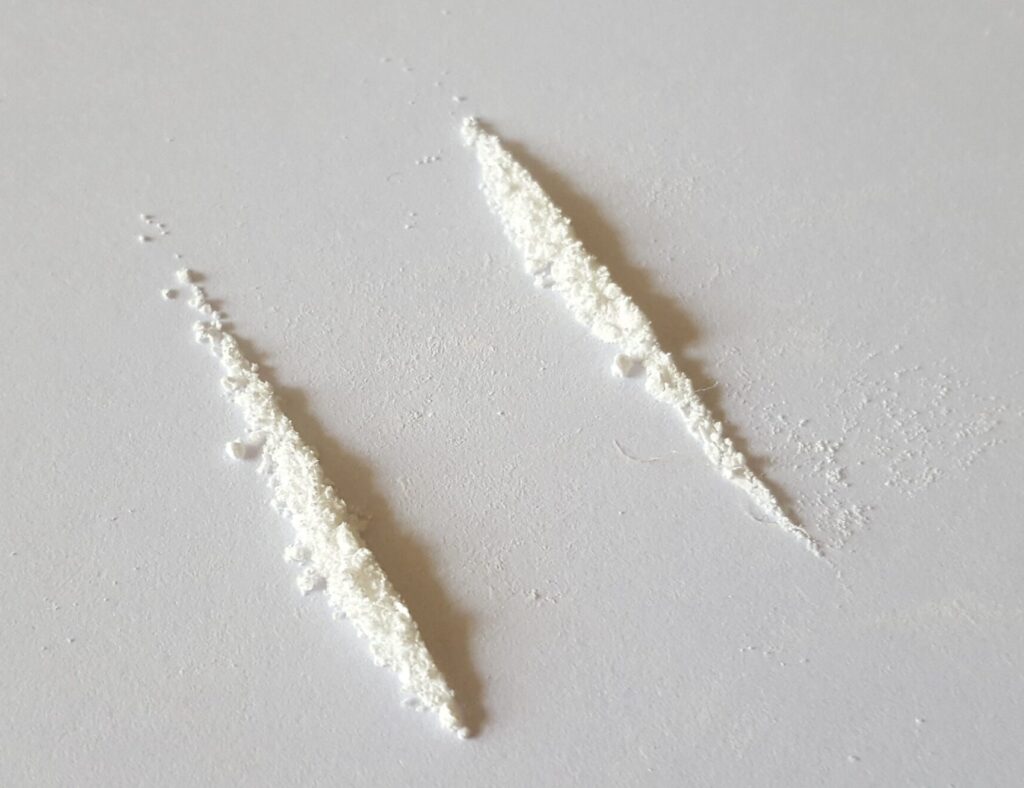
Powder: a white flakey powder, of pearly appearance in its purer forms.
Base (crack): white or off-white, pearly or waxen lumps.
Method of Use
Snorted: Powder cocaine is usually divided into lines and snorted (insufflated) via rolled up paper or ‘bumped’/‘keyed’ i.e. small amount sniffed
Swallowed: Powder cocaine is sometimes swallowed (ingested) by ‘bombing’. A ‘bomb’ is prepared by wrapping individual doses in cigarette paper.
Smoked: Smoking powder cocaine in a joint (rare as easily burns out), or crack smoked (inhaled) through pipes, ran on foil or smoked in a joint
Injected: Powder cocaine can be dissolved in water and injected. Crack may also be injected if combined with a water and acidifier to make it water-soluble.
The onset, absorption, and duration of cocaine’s effects depend on how it’s taken.
- When smoked or injected, almost all of the cocaine is absorbed: it takes only a few seconds to start feeling the effects which wear off after around 10 minutes.
- When snorted, around 60–80% of the cocaine is absorbed: the onset takes a few minutes and effects last for around 1 hour.
- When swallowed, around 30% of the cocaine is absorbed: the onset takes up to 40 minutes and lasts up to 3 hours.
Snorting or swallowing is the more gentle method of ingestion, and the onset of its effects more gradual. The onset of injected cocaine is very fast, taking only a few seconds to reach the brain, and is very intense. The short duration of effects (regardless of the route of administration) can lead to a psychological craving and urge to redose.
Pharmacology
Cocaine is a serotonin-noradrenaline-dopamine reuptake inhibitor (SNDRI), which increases levels of these neurotransmitters in the gap (‘synapse’) between nerve cells. It does this by blocking the monoamine transporters SERT (serotonin), DAT (dopamine), and NET (noradrenaline/norepinephrine). Blocking these transporters prevents neurotransmitters from re-entering the nerve cell, leading to accumulation at the synapse where they activate their receptors to produce cocaine’s stimulating effects.
The way that powder cocaine produces its effects is the same as crack cocaine; the difference is that powder is usually snorted, while crack is usually smoked.
In the liver, cocaine is broken down into the inactive benzoylecgonine metabolite. However, when cocaine is taken alongside alcohol, some cocaine and benzoylecgonine can be converted into cocaethylene: an active stimulant which lasts longer than cocaine and is associated with a significantly increased risk in heart failure.
Contrary to popular belief, evidence does not suggest that cocaethylene is any more toxic to the heart than cocaine itself. Instead, the combination of cocaine and alcohol can lead to individuals taking more of both, while alcohol disrupts the metabolism of cocaine leading to higher levels of cocaine sticking around in the bloodstream for a longer time. Overall, this puts more pressure on the brain and body than cocaine alone, increasing overall health risks.
Cocaine is non-selective with a slight preference for DAT over NET and SERT, though it is mostly studied in relation to dopamine. Compared to amphetamines, which compete for dopamine through the transporter, cocaine directly sticks to and blocks DAT. However, scientists remain unsure if cocaine both inhibits and reverses dopamine transport, causing dopamine to be ejected from nerve cells into the synapse, in a similar way to amphetamines. This uncertainty comes from the fact that ‘atypical’ dopamine reuptake inhibitors, like bupropion and modafinil, do not produce euphoric and reinforcing effects to the same extent.
Sodium channels are blocked by cocaine in a similar way to local anaesthetics like novocaine, which stops sodium from entering the nerve cells. This quickly prevents tactile and pain signals from reaching the brain, leading to cocaine’s common numbing sensation. However, other substances (like procaine, also known by its commercial name ‘novocaine’) can be cut into cocaine to simulate a similarly numbing effect.
History
Origins of coca and cocaine
The leaves of the coca plant (Erythroxylon coca) have been used for thousands of years. It grows indigenously on the slopes of the Andean mountain range, but has been cultivated by people across the whole of western South America for centuries. The leaves are traditionally chewed or drank in a tea for a number of ancestral, social and medical purposes. They are chewed not merely for its stimulant properties: they ward off fatigue, acting as a mild anesthetic that provides energy boosts for walking and working; they help alleviate the physical effects of low oxygen levels at high altitudes; and they help stave off hunger and tiredness.
When the Spanish ‘conquistadors’ arrived in South America, they initially dismissed tales of coca’s potency as native superstition. However, once they learned how effective it actually was, and how poorly the natives coped without it, they quickly moved to regulate and tax it, introducing a ‘tithe’ as they developed and imposed an administrative system on the indigenous people.
Coca eventually reached Europe via trade routes, but it did not travel well and much of the plant’s potency was lost during the long travel times of the period and crude storage methods. It was not until 1855 that the German chemist Friedrich Gaedcke isolated the cocaine alkaloid, which he named ‘erythroxyline’. Another German, Richard Willstatter, synthesised the cocaine molecule in 1898.
In 1863 an Italian chemist named Angelo Mariani brought onto the market a wine called Vin Mariani, a potent mix of wine and coca leaf. The ethanol in the wine acted as a solvent and extracted the cocaine from the leaves, while the combination reinforced the impact of both drugs and had a range of effects that are both intoxicating and euphoric, and dangerously toxic. It is well known that Pope Leo XIII consumed it daily, even awarding it a Papal seal of approval. It is reported that Vin Mariani was an inspiration for John S. Pemberton, the creator of the original Coca-Cola beverage: a carbonated, non-alcoholic drink containing coca leaves and caffeine-containing kola nuts.
Cocaine’s influence on popular culture
The drug affected many of the great writers of the time, including Henrik Ibsen, Émile Zola, Alexander Dumas and Jules Verne, appearing at times in their works. Sir Arthur Conan Doyle made Holmes a user by injection (see ‘The Seven Percent Solution’), much to the disapproval of old Watson. Robert Louis Stephenson wrote ‘The Strange Case of Dr Jekyll and Mr Hyde’ during a six-day binge; it has been suggested the duality of the central character is a rumination on the positive and destructive effects of the drug.
Cocaine was hailed as something of a ‘wonder drug’ in the late 19th Century, with exponents such as Sigmund Freud praising its anaesthetic and psychological uses, particularly in the treatment of addiction. Many products, not just medicinal but even foods (Coca Cola perhaps being the most famous), began to contain it, and there was little appreciation of its own addictive properties – the actress Tallulah Bankhead commented: “Cocaine habit-forming? Of course not. I ought to know. I’ve been using it for years”. During the First World War, Harrods in London would sell a field service kit described as ‘A Welcome Present for Friends at the Front’, containing cocaine, morphine, syringes and needles. Back then, both of these substances were sold over the counter without a prescription.
Cocaine had a less blatant profile in the first half of the twentieth century, in part due to the social, legal and moral attitudes to intoxication particularly in the United States, where the ‘cocaine crazed negro’ became a fantasy figure of fear particularly among white supremacists. Tales of coloured criminals, driven by an insatiable lust for white women and that could not be stopped by bullets were commonly shared in the tabloid press in the years before the Second World War.
This was a time when other drugs, such as amphetamines, cannabis and LSD became more popular, although cocaine was still widely used by jazz musicians, many of them had switched to heroin as their drug of choice. It experienced a revival, however, in the late 1970s as the drug of choice amongst young, hard-working, hard-partying professionals, and has seen a resurgence in its general popularity since. A decade later it was the drug of choice for the upwardly mobile aspirational world of high finance and corporate trading.
There is a fascinating relationship between Hollywood and cocaine. Cocaine is the means by which the heroes of ‘Easy Rider’ tried to get rich quick and fail. Many of the great American writers and directors have found the energising, stimulating effects of the drug irresistible for connecting, writing and producing works of art. Coppola, Scorsese and Oliver Stone have spoken at length about their challenges with cocaine use, as has Stephen King. Virtually every crime or gangster movie has cocaine involved in some fashion; many famous actors and actresses have spoken publicly about their dependence on the drug.
Crack cocaine
Cocaine was extremely popular in the USA in the 1970s – it is from this root that ‘freebase’ evolved, although with much less popularity. As with powder cocaine, the users of freebase tended to be rich, middle class and white. Freebase had little use in medicine, unlike cocaine, but a base form of the drug is required to purify towards the common salt version of the drug, cocaine hydrochloride. There are various theories about the huge rise in popularity of crack, which include the advantage over ‘freebase’ due to the tricky manufacturing process and the danger of fire and explosion caused by ether.
The simplicity of making crack – which gets its name from the popping sound it makes when smoked – was a major factor that led to crack becoming more widespread in the 1980s. Cocaine supply also increased, reducing the price. Crack provided an intense high very quickly, relatively cheaply (per rock) and did not require the use of needles. For sellers, crack was a lucrative product – easy to make and desired by a huge consumer base for whom powder cocaine had previously been culturally inaccessible and expensive in gram deals. The association of crack with poor, urban areas where it was sold, and the violence connected with the rapid expansion of the crack market, changed the American perception of cocaine. Through the 1980s and 1990s there was an explosion of news coverage of crack and fear of an ‘epidemic’ of drug use in Black neighbourhoods.
To read more about coca and cocaine, including its production, use, and distribution, visit TalkingDrugs.